
Timothy 2:15 “Be diligent to present yourself approved to God, a worker who does not need to be ashamed, rightly dividing the word of truth.”

In the final part of this study, we are going to see how rightly dividing is very helpful when studying obscure passages, like some in the book of James; but especially a couple in Hebrews 6 & 10 that have tripped up more than a few.
–
TO Whom.
Here is where determining “TO whom” and “FOR whom” really comes in handy. The verse below is a perfect example of how NOT knowing “TO whom” the author is speaking can be misunderstood and thereby misapplied. It has terrified and mislead many into believing something that is absolutely not true: “Who is your brother.”
–
Who Is Your Brother?
1 John 3:15 “Whoever hates his brother is a murderer, and you know that no murderer has eternal life abiding in him.”
The most misunderstood word in this passage is, “Brother.” That is why it has been underlined. Ever had some well-meaning Christian come up to you and ask you, “Who is your brother?” As a non-Jewish believer, you would probably answer, “Other Christians,” meaning other believers, right? Me, too…..until I learned the truth.
–

But if that’s what John actually meant here, THEN WE’RE ALL IN BIG TROUBLE! Let’s face it: Every one of us have hated another believer at one time or another, (myself included) right? That means we are all murderers! 🤯 Does that mean we can lose our eternal life?

{Sigh/groan. Here we go again} NO, of course not! That would mean the Bible is contradicting itself. It says “WE HAVE,” …..not “We’re trying to get…..” WE HAVE ETERNAL LIFE.”
How can it be “ETERNAL” if you can lose it? If you can lose it, THEN IT ISN’T “ETERNAL.”
Jesus would have said, “You have this life, but it is only until you commit some really, really, really big sin,” or words to that effect, if there was something you could do that was bad enough to cause you to lose it. But He didn’t. He Himself used the word, “ETERNAL.” So, since the Bible does not contradict itself, there must be something that WE don’t understand. I’d believe Jesus if I were you.
That should end the discussion right there. But no, there’s always somebody out there who doesn’t know how to rightly divide and/or does not understand context. They go and get confused even more by the passages below and try to complicate things. Let’s look at a few.
TO Whom.
Let’s determine the proper CONTEXT of 1 John 3:15. TO WHOM is John writing? THE JEWS. He wrote the verse this way because of the custom of Jewish Christians. They, in fact, do call their unbelieving counterparts, “Brother.”
John is differentiating between saved JEWS and UNsaved JEWS. He is not addressing non-Jewish believers here. Non Jewish believers do not call unsaved people “Brother.” What John is saying here is, “Those (Jewish people) who are saved, love; those (Jewish people) who are unsaved, hate.” That’s how they would distinguish believing Jewish bretheren from an those who are unbelievers.
–
TO Whom.
James is another book that trips up the non-Jewish Church. Look at the opening verse of his epistle: “James, a bondservant of God and of the Lord Jesus Christ, TO THE TWELVE TRIBES SCATTERED ABROAD: Greetings. (James 1:1).
Again, TO whom is he writing? The Jewish dispersion, meaning the 12 tribes of the diaspora, NOT the non-Jewish church. If you read carefully, you’ll see He is discussing being justified before MAN not about being justified before God.
How are we justified before God? By works or by faith? BY FAITH, of course. So, because scripture does not contradict itself, James cannot be referring to being justified by works in order to be made righteous or to be acceptable to God.
This is another whole topic in an of itself. If you’d like to read more, you may follow the link below:
TO Whom?
The declaration, which appears in 1 Peter, also applies to his 2nd epistle:
“Peter, an apostle of Jesus Christ, TO THE PILGRIMS OF THE DISPERSION in Pontus, Galatia, Cappadocia, Asia, and Bithynia, elect according to the foreknowledge of God the Father, in sanctification of the Spirit, for obedience and sprinkling of the blood of Jesus Christ: Grace to you and peace be multiplied.”(I Peter 1:1-2 )
Peter was also addressing THE JEWISH DIASPORA. When you read these epistles that are written TO the Jewish people, keep that fact in mind. Not all of it may apply to you, though the information may prove helpful and insightful.

TO Whom.
Here’s another confusing passage that might trip you up:
“For the time has come for JUDGMENT TO BEGIN AT THE HOUSE OF GOD; and if it begins with us first, what will be the end of those who do not obey the gospel of God?” (I Peter 4:17)
One could conceivably read this and be afraid to ever go to church again, thinking that judgment is going to fall on “US”….at Church no less! 🤯
Nope. FEAR NOT, Church! This was written by Peter 10 or so years before Herod’s temple was burned to the ground, which they called, “THE HOUSE OF GOD.” He knew that its destruction was going to happen because Jesus had told His disciples so before He died. Peter wrote this to warn fellow Jews of that fact. If they chose to continue rejecting Jesus, judgment was going to fall, BEGINNING WITH THE JEWS, in the destruction of the PHYSICAL temple in 70 A.D. That’s why he said, “Judgment will begin with us,” referring to his fellow Jews. Back then, the physical temple was referred to as the “House of God,” even by Jesus Himself.
If this passage were really referring to the you and I, Church, it would mean the Bible was contradicting itself. IT IS NOT.
Paul himself wrote TO the non-Jewish Church, “There is therefore now NO CONDEMNATION {no judgment} for those who are IN CHRIST JESUS.”
Jesus has already taken away ALL our judgment. What is left to punish if they are ALL put away? The fact is, there’s nothing left to punish. God punished His Son instead of us. THERE IS NO JUDGMENT LEFT.

TO Whom.
Hebrews 10:26-27. “For if we sin willfully after we have received the knowledge of the truth, there no longer remains a sacrifice for sins, but a certain fearful expectation of judgment, and fiery indignation which will devour the adversaries.”
Now this is a passage that has REALLY tripped up some in the Church. I’ve heard some fiery sermons on this one. I’m sure you have, too.
First of all, every sin is a “Wilful sin.” So why does Paul make a point of calling this particular sin, “Willful?” Remember what we learned about CONTEXT. Once again, who is being addressed here? THE HEBREWS (JEWISH PEOPLE.) These Jews actually knew that Jesus was the Messiah, yet they persisted in rejecting Him. They never internalized that knowledge and became born again.
The particular sin that Paul is referring to dealt with these unsaved brothers. These Jews who “Sinned willfully,” even though they agreed Jesus was the Messsiah, were never truly saved. Knowing Who Jesus is but CONTINUALLY rejecting Him IS A WILLFUL SIN.
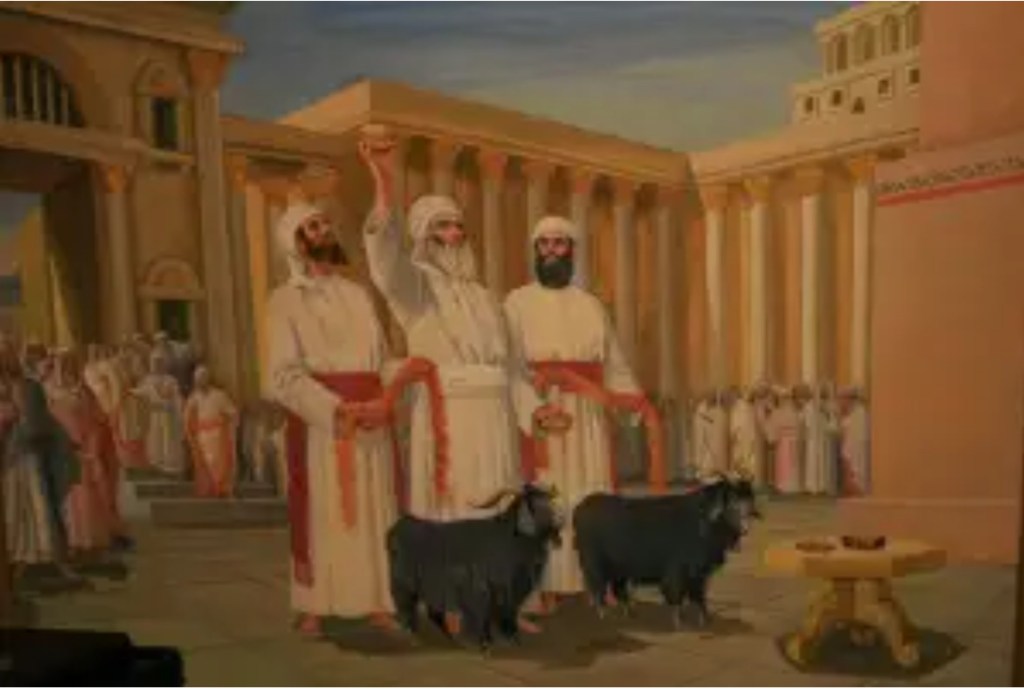
As I said above, which bears repeating, prior to the destruction of the Temple, many who knew Jesus was the Messiah thought, just in case He wasn’t, that they’d hedge their bets by also going to the temple to offer bulls and goats. They also fellowshiped with their born-again brethren, yet never came to faith in Christ.
THEY WERE NEVER SAVED.
No wonder they were fearful! Now that Jesus had shed His perfect blood, the blood of bulls and goats isn’t gonna cut it any more. JESUS IS THE ONLY ACCEPTABLE SACRIFICE FOR SINS. THERE IS NO OTHER.
So…..if you were depending on the old system, all you had now was a FEARFUL EXPECTATION OF JUDGMENT and rightly so. You were told that God no longer accepts those offerings.
Does all of. that mean we shouldn’t read those books because there is nothing for us? No, of course not. Just don’t be confused by messages that don’t apply TO you. It should be of great comfort to KNOW that you are forever secure, forever righteous, hid with Christ in God! Amen, Amen!
Did you ever notice that none of these men who wrote TO the Jews ever talk about Jesus seated at the right hand of God or the Church as the body of Christ? Why? Because all those kinds of teachings came solely from the Apostle Paul by revelation, directly from The Source: JESUS HIMSELF.
These men, who walked and talked with Jesus while He was physically here on earth, surprisingly, had a very hard time understanding that His coming to earth was more than about restoring the Kingdom to Israel.
As we talked about in an earlier part of this study, they were a bit exclusionary in their thinking. They thought that the Messiah was only for the Jews. They didn’t understand the concept of the Church, of Gentiles getting saved, nor of the Gospel being meant for the ultimate salvation of the whole world. It took them quite a while to come to grips with the idea.
In order for Jesus to have restored the kingdom to Israel at that time, their leadership would have had to accept Him as their Messiah in His first coming. Had they done so, there would be no need for a second coming. But, as you know, they rejected Him as a nation and, sadly, for some two thousand years, they have suffered as a result. But the Gentiles have benefitted.

Shepherding God’s People: A Note To Pastors:
Pastors and teachers, I know you won’t hesitate to read or study any part of the Bible. If you keep in mind the principles of context and of rightly dividing the covenants, it will result in better understanding and more accurate exegesis. I’m sure you don’t want misunderstandings or inadvertent misapplications of God’s word, nor do I. You want to see your people flourish and succeed, to be excited to tell others about this wonderful Jesus! Imagine needing larger churches that rise out of necessity to provide a safe place for many to hear the truth.
I know that your own walk with Jesus will be all the better. It will be amplified and sweeter when you understand that you are under God’s grace, not the law, and greatly loved. Though we all commit sins, we are no longer punished by God because Jesus took ALL our punishment on Himself. He killed His own Son instead of us. Human consequences still apply, of course; but between us and the Father, the war is over.
There was a Pharisee with whom Jesus dined and to whom he explained this entire topic in a story we can all understand. You may follow the link below to read more:
It’s absolutely critical to understand that not everything in scripture applies TO you personally or TO your Church. Undershepherds in particular need to be very careful as we have a greater responsibility than the average Christian. We especially must NOT to mix up the covenants because our teaching affects the sheep of Jesus’ fold. He doesn’t take kindly to any of His under shepherds beating His flock, meaning teaching them law mixed with grace.
Also, when studying the Old Testament, I encourage you to go there to see Jesus hidden in all the scriptures concerning Himself. He is quite literally hidden in every line of the original languages if you know how and where to look! Unveil His beauty to your people. Show them how to see Him in different types, offices, and stories of the Old Testament. Paul’s letters are a great help in uncovering the meaning in various typologies. The book of Hebrews is particularly useful in understanding all these things.
Of course, and above all, we can totally rely on The Author of the scriptures, The Holy Spirit, for insights, instruction, and fresh manna. He is the greatest teacher of all.
Full Maturity.
It’s high time The Body of Christ to comes to full maturity in Him and know how to RIGHTLY DIVIDE THE WORD OF GOD. We will all grow spiritually and flourish “like the palm tree, planted by rivers of living water!” There isn’t a more important skill that any of us–Pastor, teacher, theologian…..or rank and file–can develop than this: TO RIGHTLY DIVIDE THE WORD OF GOD.
–
Thanks to all of you for your kind attention to this study. I truly hope this series has helped and blessed you. If you missed any part and would like to follow along from the beginning, below is a link to part 1:
Be greatly blessed, highly favored, and deeply loved. Grace, blessings, and Shalom in Jesus’ Name, AMEN.


![The Five Offerings Of Leviticus Part 9 of 10: The Trespass Offering, Asham [אָשָׁם]](https://emmausroadministries.international/wp-content/uploads/2021/02/img_0218.jpeg?w=1011)


 Emmaus Road Ministries
Leave a reply to Keeping The Bible In Context: Part 15 of 16—Rightly Dividing The Word Of God – emmausroadministries Cancel reply